Monday, July 10, 2006

Awesome Coke Spot!


Totally amazing Coke spot from Wieden + Kennedy and Psyop.

Check out the killer Coke Spot!

Pump It Up!


Looking for just the right music to make your spot or movie as truly impactful as it can possibly be?

What about hosting your band's music with some folks that can get you maximum exposure and maybe even use your music in the next killer Mentos commercial?

Founded in 2001, Pump Audio is a new kind of agent for independent musicians, digitally connecting them with buyers in the mainstream media. With Pump Audio, artists can license their music into productions without giving up any ownership, while TV and advertising producers can discover new music ready for use. With a growing catalog of tens of thousands of songs, all by independent artists from around the world, customers access music through Pump’s innovative search software and delivery device, the PumpBox™. Pump Audio is based in New York's Hudson Valley.

What are you waiting for?

Check out Pump Audio and make it happen!

That's Right,

HMK

Saturday, July 08, 2006

A Whole New Game Ball


The NBA is introducing a new Official Game Ball for play beginning in the 2006-07 season. The new ball, manufactured by Spalding, features a new design and a new material that together offer better grip, feel, and consistency than the current leather ball. This marks the first change to the ball in over 35 years and only the second in 60 seasons. In 1970, the ball was transitioned from a four panel to an eight panel ball. NBA Commissioner David Stern, Spalding Group Vice President Dan Touhey, NBA Sr. Vice President of Basketball Operations Stu Jackson, Boston Celtics’ Forward Paul Pierce, and NBA on TNT analyst and two-time NBA champion Kenny Smith unveiled the new Game Ball today at the NBA Store on Fifth Avenue prior to the 2006 NBA Draft.

The new ball features Spalding’s Cross Traxxion™ technology, a union of revolutionary design and breakthrough material. The design is comprised of two interlocking, cross-shaped panels rather than the eight oblong panels found on traditional basketballs. As a result, there is more material coverage. The material is a microfiber composite with moisture management that provides superior grip and feel throughout the course of a game. Additionally, the new composite material eliminates the need for a break-in period, which is necessary for the current leather ball, and achieves consistency from ball to ball.

The interlocking cross-panel design has one-third the channel area of the previous official ball to provide more material coverage and better grip.

The NBA and Spalding subjected the ball to a rigorous evaluation process that included laboratory and on-court testing. Every NBA team received the new ball and had the opportunity to use it in practice. The ball also was tested in the NBA Development League and was used in activities during NBA All-Star 2006 in Houston. NBA retired players Steve Kerr and Mark Jackson participated in testing the new ball as well.

“Spalding’s continual efforts to advance basketball technology have yielded the optimal ball, one that is worthy of the new Official NBA Game Ball designation,” said Spalding Group President and CEO Scott Creelman. “We are honored that the NBA collaborated with us to make this change.”

The ball will be used in all NBA events leading up to next season including summer leagues, preseason and training camps, and NBA Europe Live presented by EA Sports. All active players will receive a personalized ball, as will each player selected in the 2006 NBA Draft.

Fans will have an opportunity to see the new ball tonight during the 2006 NBA Draft televised live on ESPN at 7 p.m. EST. The ball will hit store shelves at major sporting goods outlets on October 31 coinciding with the tip-off of the 2006-07 season. A limited number of new balls will be available today at the world’s only NBA Store on Fifth Avenue in New York City. Fans can also pre-order their new ball online at NBAStore.com for delivery at the start of the 2006-07 season.

As the Official Game Ball supplier of the NBA since 1983, Spalding will continue to produce the only basketball used during all NBA practices, exhibitions, games and international competitions. Spalding maintains the exclusive rights to produce and sell a complete line of NBA and team-identified basketballs in all sizes including full, junior, youth and mini.

Thursday, July 06, 2006

iLuv At First Sight!


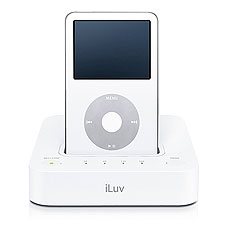
iLuv has just announced a sweet little dock that allows users to record videos directly to a fifth-generation iPod from from any video source (TV, DVD player, camcorder, etc.). The iLuv i180 iPod dock's got four recording time settings—30 min, 60 min, 120 min, 180 min—and basic record/stop and timer buttons.

According to the site, once a video is recorded, it can be found and played on the iPod under Videos > Video Podcasts > iLuv. The i180 also charges a docked iPod and has composite AV (RCA) and S-Video connections. Availability is set for mid-August and estimated damage is $200.

Sounds cool: iLuv.

That's Right,

HMK

Wednesday, July 05, 2006

It's All About The View


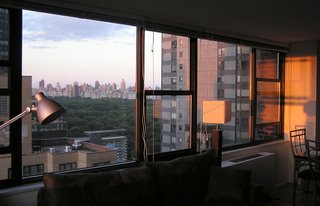
My buddy Jackie was kind enough to let me flop at his place on West 57th while he was working in New York last September. I took this from the living room on the 23rd floor overlooking Central Park. Yeah, it was pretty sweet.

The following is by Suzanne Slesin from yesterdays NY Times

An expansive, gorgeous view of Central Park. A lifelong dream for me.

Many years ago, while living in a 20th-floor apartment on East 79th Street, I would go out on our small terrace, look left and get a glimpse of a sliver of treetops. So the idea that I could have a magic-carpet view of The Park as I drank my coffee every morning was reason enough to propel me to 110 Central Park South, the new co-op (with condo bylaws) that's smack across from the southern tip of the park.

(I had also experienced the park from a similar vantage point when I went to a dentist years ago whose office was just down the street on a stretch of Central Park South known then as Valley of the Drills.)

Situated between the Avenue of the Americas and Seventh Avenue, 110 Central Park South is a 1920's building with a neo-Renaissance palazzo exterior, designed by James Edwin Ruthwin Carpenter, an architect known for such luxury residential projects as 810, 907 and 1115 Fifth Avenue.

Turned into the 25-story, 118-unit apartment hotel known as the Navarro in 1927, it subsequently was the site of the Ritz-Carlton and InterContinental Hotels. Now, Anbau Enterprises — run by the husband-and-wife team of Stephen Glascock and Barbara van Beuren — is converting it to co-ops.

There was no way the views could disappoint.

And Stacey Greenfield, the director of sales for the Sunshine Group Ltd. who met me in the small yet elegant sycamore-lined lobby, was the first to assure me of that.

Anbau and Sunshine each plan to give 0.5 percent from the sale of every apartment to the Central Park Conservancy. "I don't know how many sponsors do that," Ms. Greenfield said. "Giving back to the city is part of this project."

"I'm all for that," I say to myself, as I am swiftly led to the elevator, also lined in sycamore. (There's no attendant, but the building has 24-hour doormen.) We zip up to the sixth floor where the model apartments are on display.

While the prewar facade was retained, the interior of the building has been gutted and divided into 61 one-, two- and three-bedroom apartments. Costas Kondylis & Partners was the architecture firm, and Gustavo Martinez Design was responsible for the interiors.

"Because people are combining units," Ms. Greenfield said, "the total number of individual units will probably drop down to 50."

Three new floors were also added, and there are now full-floor apartments on the 22nd to 29th floors. "These were the first to be sold and range from $13 million to $15 million," said Ms. Greenfield, who added that her clients were "a lot of empty-nesters who are either buying large apartments, or scaling down, or people who did not have a park view."

We start by looking at 6B, a furnished three-bedroom with three full bathrooms, a powder room and about 2,400 square feet. Only two B-line apartments are still available: 9B ( $5,038,800, with a monthly maintenance of $6,778) and 5B ($4,467,600, with a monthly maintenance of $6,564).

"We sold as fast on the lower floors as the high ones," Ms. Greenfield said.

I take in what she is saying while feeling drawn like a magnet to the windows. The view of the treetops is as lovely as expected: an expanse of green shapes, framed by the towers on Fifth Avenue and Central Park West. I feel as if I'm in a scene right out of Ludwig Bemelmans or Raoul Dufy. I half expect to see children in sailor suits chasing after hoops.

Ms. Greenfield interrupts my little reverie. "You are in contact with the street," she said. "You have the lake — it's all very picturesque." I agree.

The combination living and dining room overlooks Central Park, of course. "We kept it all open," Ms. Greenfield said, "because that's the way people live today."

I'm already backing into the sleek kitchen, keeping my eyes on the view while admiring the Poggenpohl cabinets, the Miele oven and cooktop, the Viking wine cooler and the smooth quartz countertops. I like the idea of the breakfast niche that seats up to six people, but wonder why it's so close to the dining area.

We move to the private areas, slipping out the kitchen door and going down hallways and galleries to experience what Ms. Greenfield calls "the flow." No wide-open spaces here. Rather, I am noticing the nooks and antechambers that are meant to reflect the graciousness and formality of Old World residences.

Ms. Greenfield points out the nine-foot coffered ceilings, the Art Deco-inspired marble bathrooms, the dressing rooms, the solid doors, the chrome hardware, the sconces and the chandelier-ready ceilings.

"Even though everything is new, it has a solid feel to it as if you were in a real prewar apartment," she said. "You never walk directly into your bedroom. Every room has an entryway; every bedroom has its own bathroom. The apartment feels like a home — you're always walking, walking, walking."

But on the sixth floor, the quite spacious master bedroom at the back of the apartment faces a brick wall. The magical feeling of the front rooms is dimmed.

We move next door to visit the A apartment, with two bedrooms, two baths and a powder room and a total of about 1,850 square feet. It is smaller, yet somehow more appealing. The master bedroom is on the park, and although the kitchen lacks the dinette, it has a free-standing work counter that allows for an unobstructed view of the park. Not surprisingly, only two such units are still available: 4A ($3,857,700, with a monthly maintenance of $5,059) and 21A ($6,601,218, with a monthly maintenance of $5,924).

"Many people are combining the A and B units," Ms. Greenfield said.

Only one of the seven full-floor units is still available, Penthouse 23, on the 23rd floor. The apartment, with 4,184 square feet but no terraces, is priced at $14.35 million and has a monthly maintenance of $12,383.

The view is jaw-dropping — a lush green carpet unfurled as far as the eye can see, bordered with a procession of New York City buildings that look just out of a movie set.

So far, the space has been left open, interrupted only by a set of structural columns ("they could be made into great bookcases," Ms. Greenfield offered) and a maze of other rooms — bedrooms, dressing rooms, closets and bathrooms.

On the high floor, you pick up a western exposure with its view of the Time Warner Center, and to the south, a peek at the Empire State Building. Ms. Greenfield points out rooms that can be sealed off for privacy, bathrooms that can be enlarged, bedrooms that can be turned into studies. And of course, prewired corridors that cry out for sconces. Just bring on the decorator, I want to shout.

On the way down, I stop to take another look at my favorite A-line unit, in which one could wake up and see the park without getting out of bed. That would be nice, very nice.

And probably fabulous enough.

That's Right and thanks again Jackie!,

HMK

Tuesday, July 04, 2006

Cheers To Your Health


Karla is a new beer for women, marketed as improving health and well-being.

German brewer Karlsberg (not to be confused with Danish Carlsberg), is convinced that it can get more women to drink beer. In countries such as the UK and Spain, roughly equal percentages of men and women drink beer (around 40%). Surprisingly, this isn't the case in Germany, where women view beer as unhealthy, fattening, or unsophisticated.

So Karlsberg is taking a different angle with its introduction of Karla. Stressing that beer is a natural product, Karla is being promoted as a healthy drink for women. The mixed drink is attractively packaged, and comes in two varieties. Both are low in alcohol content (1%) and a blend of beer and fruit juices. Karla Balance claims to provide 'peace and balance' by mixing hops with lemon balm, an herb well-known for its sedative properties.

The other variety, Karla Well-Be, is also an offspring of the functional foods / nutraceuticals trend. Ingredients include soy-derived lecithin (which may positively affect cholesterol levels), folic acid (recommended for women considering pregnancy), and other vitamins.

Emphasis on health prompted an unusual distribution channel: Karla is sold through pharmacists. After a soft launch in 2005, Karlsberg recently teamed up with neutraceutical manufacturer Amapharm to distribute Karla to pharmacists across Germany. International expansion is in the works.

With health and wellness driving many consumers' food and drink choices, this could be a (niche) hit with health-concious consumers across the world, not to mention with women who actually enjoy watching soccer while knocking back a cold one.

Friday, June 30, 2006

Cannes Lions International Ad Festival


Along with the other purposes it serves, (excuses to eat, swim, drink and frolic) the Cannes Lions International Ad Festival is also a window on the best and most interesting TV commercials produced outside the U.S. each year. Check out 10 Spots from other countries that were standouts at this year's event.

That's Right,

HMK

Thursday, June 29, 2006

Right On Time


Agency: Jung Von Matt, Hamburg.

Animation Archive

Click To Enlarge

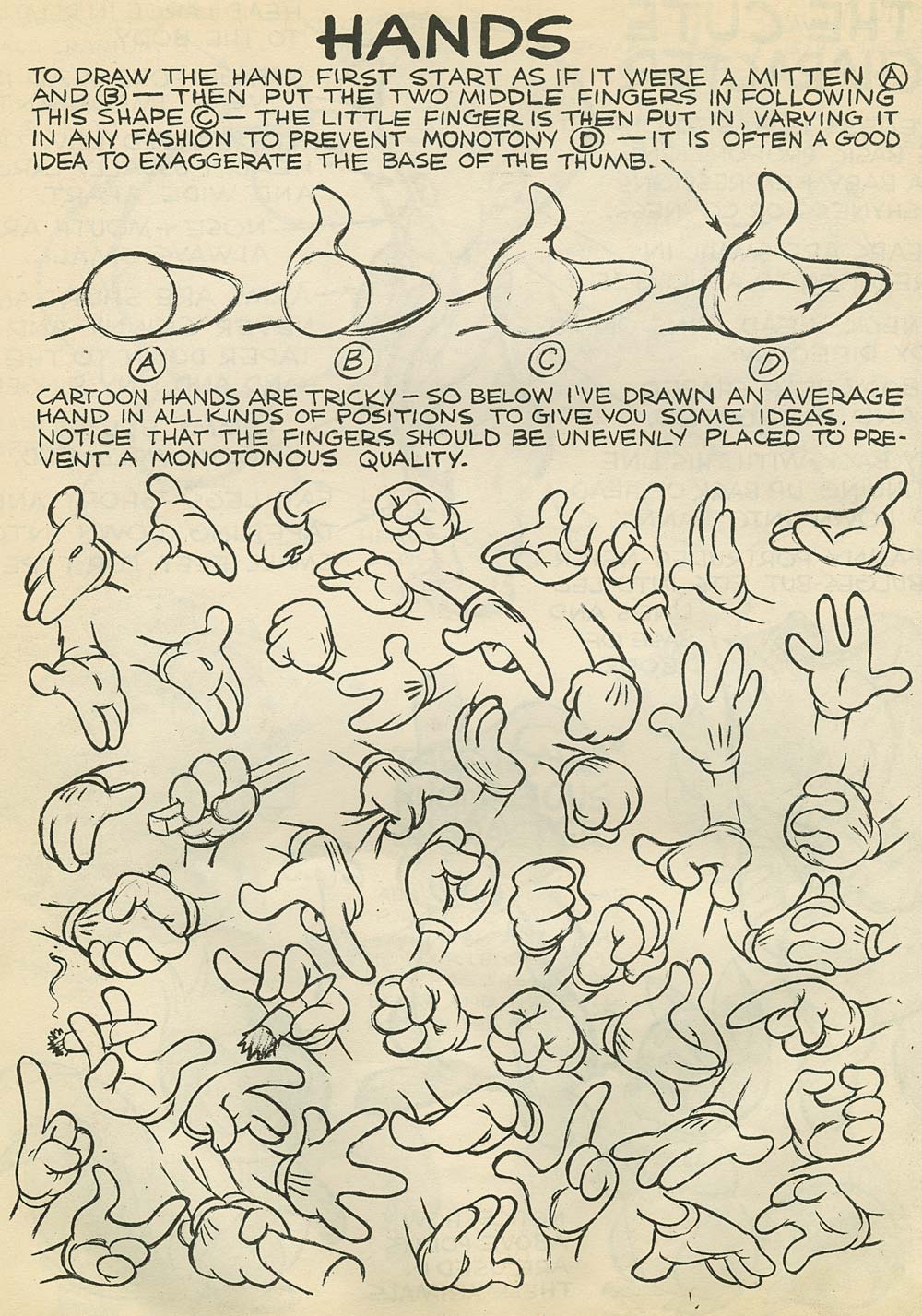
Just a small sample of some of the awesome animation and drawing tips at the International Animated Film Society.

The International Animated Film Society: ASIFA-Hollywood has embarked on an ambitious project to create an animation archive, museum, and library for the benefit of the animation community, students and general public. The first phase of this project involves the creation of a VIRTUAL ARCHIVE which will house images, movie clips and sound files pertaining to the art of animation.

Get your pencils out!

That's Right,

HMK

Tuesday, June 27, 2006

No Brainer


DaimlerChrysler will finally be selling its smallest Smart car, a minicar that fits on top of a regulation pool table, in the U.S as soon as 2008. It's about time...

That's Right,

HMK

Monday, June 26, 2006

The Mysterious Power of Context

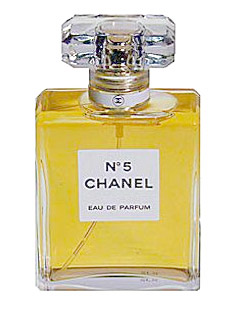
Label for Chanel No. 5, Gabrielle Bonheur "Coco" Chanel, 1921
Story thanks to Michael Bierut

A while ago, I was designing the identity for a large, fashion-oriented organization. It was time to decide which typeface we'd use for their name. Opinions were not hard to come by: this was the kind of place where people were not unused to exercising their visual connoisseurship. But a final decision was elusive.

We decided to recommend a straightforward sans serif font. Predictably, this recommendation was greeted by complaints: it was too generic, too mechanical, too unstylish, too unrefined. I had trouble responding until I added two more elements to the presentation. The first was a medium weight, completely bland, sans serif "C." "Does this look stylish to you?" I would ask. "Does it communicate anything about fashion or taste?" Naturally, the answer was no.

Then I would show the same letter as it usually appears as the first in a six-letter sequence: CHANEL. "Now what do you think?"

It worked every time. But how?

The answer, of course, is context. The lettering in the Chanel logo is neutral, blank, open-ended: what we see when we look at it is eight decades' worth of accumulated associations. In the world of identity design, very few designs mean anything when they're brand new. A good logo, according to Paul Rand, provides the "pleasure of recognition and the promise of meaning." The promise, of course, is only fulfilled over time. "It is only by association with a product, a service, a business, or a corporation that a logo takes on any real meaning," Rand wrote in 1991. "It derives its meaning and usefulness from the quality of that which it symbolizes."

Everyone seems to understand this intellectually. Yet each time I unveil a new logo proposal to a client, I sense the yearning for that some enchanted evening moment: love at first sight, getting swept off your feet by the never-before-seen stranger across the dance floor. Tell clients don't worry, you'll learn to love it and they react like an unwilling bride getting hustled into an unsuitable arranged marriage. In fact, perhaps designers should spend less time reading Paul Rand and more time reading Jane Austen: after all, it is a truth universally acknowledged that a corporation in possession of a good fortune must be in want of a logo, isn't it? Finding that one perfect logo is worth its own romantic novel.

All of this is compounded by the fact that designers themselves have very little faith in context. We too want the quick hit, the clever idea that will sell itself in the meeting and, even better, jump off the table in design competitions. More than anything, we want to proffer the promise of control: the control of communication, the control of meaning. To admit the truth — that so much is out of our hands — marginalizes our power to the point where it seems positively self-destructive. This is especially true in graphic design, where much of our work's functional requirements are minimal on one hand and vague on the other. "The pleasure of recognition and the promise of meaning" is a nice two line performance specification, but one that's impossible to put to the test.

Yet all around us are demonstrations of how effective a blank slate can be. It's just hard to learn from them. I'd like to think, for instance, that I'd see the potential of a red dot in a red circle if I was designing a logo for a company named Target. But in truth I'd probably say, "What, that's all?" and not let it into the initial presentation. How, after all, could you guarantee that the client would invest 40 years in transforming that blank slate into a vivid three-dimensional picture?

Appreciating the power of context takes patience, humility, and, perhaps in the end, a sense of resignation. You sense it in this account of designer Carolyn Davidson's disappointing presentation for her first big ($35) freelance project:

After sifting through the stack of drawings, Knight and the other men in the room kept coming back -- albeit with something less than enthusiasm -- to the design that looked like a checkmark.

“It doesn’t do anything,” Johnson complained. “It’s just a decoration. Adidas’ stripes support the arch. Puma’s stripe supports the ball of the foot. Tiger’s does both. This doesn’t do either.”

“Oh, c’mon,” Woodell said. “We’ve got to pick something. The three stripes are taken.”

That was the trouble, thought Davidson. They were all in love with the three stripes. They didn’t want a new logo; they wanted an old logo, the one that belonged to Adidas. Davidson liked [them] but found it disheartening to go out on her very first real job and get this kind of reception.

We all know the ending to this story: the client grudgingly accepted Carolyn Davidson's chubby checkmark, and the rest, as recounted here in Swoosh: The Unauthorized Story of Nike and the Men Who Played There is corporate identity history. The swoosh has proven durable enough to stand for the company's dedication to athletic achievement, its opponents' resistance to the forces of global capital, and a lot of things in between. Sometimes, the client is smarter than we think. Give Nike founder Phil Knight credit: he had the vision to admit, “I don’t love it. But I think it’ll grow on me."

Maybe he believed it. Or maybe he was just tired of trying to decide. Either way, context did the rest.

That's Right,

HMK

Friday, June 23, 2006

Oi Vey!


Leave it to Tivoli Audio. They've introduced the new iYiYi home speaker system.

Available in black or white, the iYiYi features a built-in universal docking station for use with all dockable iPods, as well as a digital AM/FM radio, built-in alarm and digital clock. The system also sports two 3” full-range drivers, a remote control, auto-brightness blue backlit LCD display, rubberized knobs, Radio Data System (RDS) support, an auxiliary input, and stereo headphone output.

Tivoli said the iYiYi—which apparently gets its name from the Yiddish phrase contextually translated as “what will they think of next?”—will be available this Fall for $300.

Tivoli Audio


That's Right,

HMK

Wow-Fi!


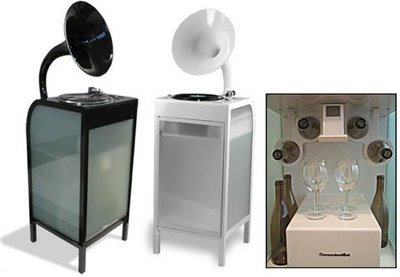
We’ve all been patiently waiting for a combination record player, MP3 player, CD player and wine/liquor rack and now CucumberLab, a design firm that specializes in making avant-garde designs for all sorts of quirky things, has delivered one unto us with its Sound Machine. The speaker is clearly inspired by the old gramophone, from which 200 watts of CucumberLab sound bellow. Never mind that it looks pretty decent, too, with a high gloss Awlgrip finish.

The wine/liquor rack holds 12 bottles, ensuring your turn-of-the-century theme party goes off without a hitch, all with grade A whiskey within arm’s reach. Just don’t get too soused that you can’t appreciate the 8” subwoofer. It’s like your house has become a speakeasy seemingly overnight. Thanks, CucumberLab & Nicholas Deleon!

Good luck getting a hold of one, though, since it’s only available in “limited production,” and their phones appear to be ringing off the hook.

Cucumberlab

That's Right,

HMK

Tuesday, June 20, 2006

With Apologies To The Little General...

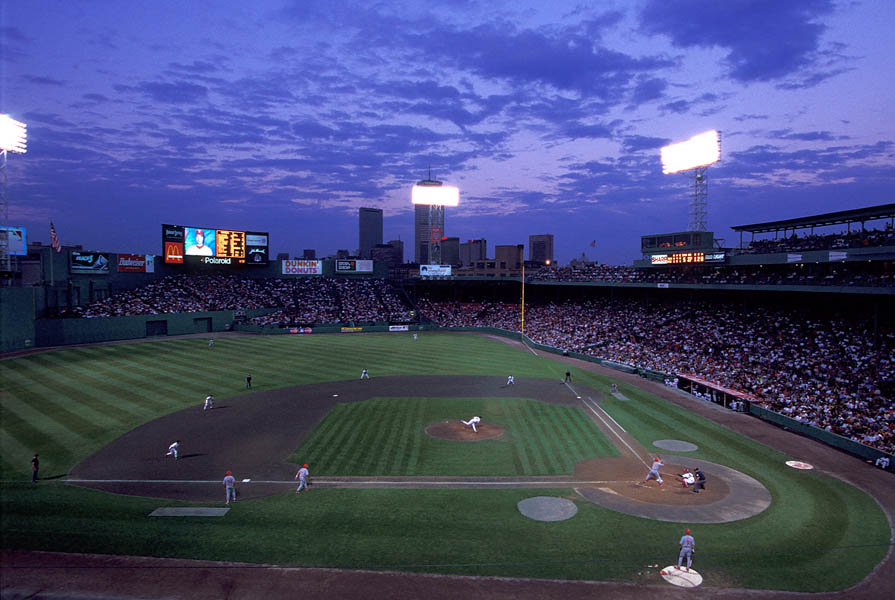
Go Sox!

Photo by Steven Pinker

If you say "pa-JAM-uzz" instead of "pa-JAHM-zz" or "yooz guys" instead of "ya'll," chances are, you're a Yankee. If you call a bag a sack or pronounce route as "rout" instead of "root," you're probably a rebel.

You can figure out just how much of Southerner you are by taking an ONLINE QUIZ called "Are you a Yankee or a Rebel?" It asks questions about how you pronounce certain words and phrases and then calculates the amount of Dixie in your speech.

That's Right,

HMK

P.S. Accoring to the quiz I'm a Yankee... Go Sox!

Monday, June 19, 2006

This Has Nothing To Do With Pink Floyd


Dig old radio?

What about Sci-Fi?

Well, you're in luck my friends - because Zombie Astronaut is back!

Forget today's fancy podcast caca and go grab some real deal old time radio classics. Perfect for your headphones and evevn better on dark rainy nights just before bedtime!

Dark Side Of The Moon
Though the original moonwalk happened just over 35 years ago (providing you don't believe it was staged), in the days preceding that historical event we were forced to imagine what it'd be like to wander the surface or the moon. Most visions of this development involved hostile alien life forms whose technology surpassed ours. In this SF68 episode, recorded roughly a year before Armstrong, Aldrin and Collins stopped by, our astronauts do encounter an alien lifeform, though it's much simpler... and much deadlier.

As the Supernova speeds toward the moon, the astronauts aboard, Dick Revero, Charles Paris and James Casey, expect to land on a barren landscape, but there's something alive there... something swirling in the dust...

Go get Dark Side Of The Moon now!

You'll dig!

That's Right,

HMK

Tuesday, June 13, 2006

Lorem Ipsum


Lorem ipsum dolor sit amet, consectetur adipisicing elit, sed do eiusmod tempor incididunt ut labore et dolore magna aliqua. Ut enim ad minim veniam, quis nostrud exercitation ullamco laboris nisi ut aliquip ex ea commodo consequat. Duis aute irure dolor in reprehenderit in voluptate velit esse cillum dolore eu fugiat nulla pariatur. Excepteur sint occaecat cupidatat non proident, sunt in culpa qui officia deserunt mollit anim id est laborum.

Excepteur sint Lorem Ipsum

Duis Aute,

HMK

Monday, June 12, 2006

Blink!


Clear Channel is discussing the idea of one-second radio spots with marketers and media buyers. Blinks are one-second commercials.

The real value of the Blinks, as they are being called, may be in the publicity they can generate. After all, you're already reading an article about them, and the short spots are only in the concept stage.

The radio giant, however, says it didn't think up Blinks as a promotional stunt. "It really is to find new uses of radio for advertisers who are continually asking us to demonstrate that our medium can successfully extend brands, can successfully reach the consumer with touchpoints that are new and surprising" said Jim Cook, senior VP-creative for Clear Channel Radio.

Audio Mnemonics
The Blinks could be used in a number of ways. Clear Channel's Creative Services Group crafted a demonstration spot using the McDonald's jingle, minus the "I'm lovin' it" language, and placed it between one hip-hop song and another. The group also created a Blink for BMW's Mini Cooper with a horn honking and man's voice saying "Mini," and placed it before miniaturized news reports. (Neither marketer has a deal with Clear Channel for Blinks.) Other audio mnemonics that could use Blinks are the Intel chime and the NBC bells.

Jim Gaither, director-broadcast at Richards Group, has been in conversation with Clear Channel about three-second spots. "It's not building a brand; it's refreshing a brand," he said, adding: "You can't use a one-second campaign for something that generally has not been advertised before."

Frequency Needed
You also need frequency, because if you just hear a sound and nothing else, the message is going to have to be driven into the consumer, Mr. Gaither said. It's also best suited to a marketer's core customer, because those are the people for whom the Blink will have the most impact, he said. Mr. Gaither said he doesn't think he has a marketer at the moment that perfectly fits the bill.

But would marketers want to be so brief? Andrew Goldstein, instructor of a broadcast-media-writing course at the Miami Ad School and a copywriter at Zimmerman Advertising, isn't convinced national advertisers would want a sound effect thrown into the programming. "You're not going to know it's connected to the brand, and it's going to lose its value," he said.

Lauren Russo, managing director-local radio at Horizon Media, said, "I can't see any advertiser, any agency paying for a spot that's one second." If Clear Channel came to her to buy the ads, she wouldn't be interested. "If they want to throw it in at no charge, I don't think we would say no," she said, but, "I just don't see how you can communicate anything in that little time period." Clear Channel said it hasn't decided on pricing and package information, but Mr. Gaither estimates that the time may be sold at a 200% to 300% increase on what one-thirtieth of a 30-second spot might cost.

Hard To Verify
And when it comes to verifying that the spot ran, there could be a problem. TNS Media Intelligence can track broadcast spots that are five-seconds or more in length, with the possibility of tracking three-second spots with some development, said Richard Radzik, VP-broadcast verification services at TNS Media Intelligence.

In the late 1990s, Cramer-Krasselt, a Chicago-based independent ad agency, did a one-second TV spot for Master Lock in which a padlock is shot with a bullet in front of a bull's-eye. The image of a high-powered rifle shooting through a Master Lock padlock had been on the Super Bowl for many years and was an icon before the one-second spot aired.
The media buy was small, as most major networks weren't equipped to handle a one-second ad, but the PR and publicity were worth millions of dollars, said John Melamed, exec VP at Cramer-Krasselt.

The big PR boon, however, may be for Clear Channel. "This is a way for Clear Channel to get more news," Mr. Gaither said. "I don't think you're going to see any kind of mass exodus from traditional 30- and 60-second radio advertising to people doing one-second spots. You're going to get a dozen people that it makes a lot of sense for ... and we'll call it a day, and Clear Channel will be the ones that were out there doing it first."

Thanks to Willow Duttge at Ad Age and SharkThang.


That's Right,

HMK

Friday, June 02, 2006

Dutch Tub


So, what's the biggest hassle with hot tubs? They pretty much have to stay in one place. The Dutchtub is a portable hot tub that warms its water by way of connected outer pipes that coil around a fire basket, letting a natural fire do the work of warming the water all the way up to 113 degrees Fahrenheit.

It also features a wine bottle holder with space for ice to keep your bubbly cool while you stay warm in the water. With optional BBQ, chimney, and trailer accessories, this would be sweet to bring to Big Bend next time we go camping!

Check out the Dutch Tub!

That's Right,

HMK

Tuesday, May 30, 2006

Now That's What I'm Talkin' About!

Speck Products has announced the SpeckTone Retro, a new iPod speaker system with some vintage Tiki Roomesque styling.

“SpeckTone Retro looks like nothing you’ve seen for the iPod. The clean lines and nostalgic elegance of 1950’s style makes a statement without replicating or competing with the modern, sleek look of the iPod itself,” says Speck. The $150 speaker system features a top-mounting iPod dock, 28 watt output, a 4” subwoofer and two 3” drivers, and support for 4G and 5G iPods, the iPod nano and iPod mini. SpeckTone Retro’s all-wood speaker cabinet is available in three high-gloss lacquered finishes—green/brown, black/black and white/silver. It will begin shipping in June.

Go Speck Products!

That's Right,

HMK

Wednesday, May 24, 2006

Seduced By Packaging?


Growing up with 5 younger brothers you'ld think that I got all the new stuff like clothes, shoes, toys and whatever while my brothers got stuck with the hand-me-downs, right? In reality, more times than not, I ended up with the dregs of my frugal parents friends and secondhand stores.

Until I was about 30 or so, breaking the shrink wrap on a new album bought with my paper route money or a piece of stereo gear from my table waiting tips was the closest I'd come to experiencing that mystical euphoria one must feel from that first wiff of that new car smell or anything else for that matter. (I'm currently driving a 94 Altima I bought used in 1995 and my two previous rides were my 1966 convertible VW Bug and a sweet 1969 short bed Chevy stepside truck.

That's probably why to this very day the thrill and ritual of opening something new makes me feel like an 8 year old on Christmas morning. With that said, and for numerous aesthetic and geeky design reasons, I'm sure you'll understand why I''m totally digging Unboxing.


That's Right,

HMK

Tuesday, May 23, 2006

Planet Claire Revisited


Some say shes from Mars or one of the seven stars that shine after 3:30 in the morning. But she isn't! Check out the amazing Real Time Satellite Tracking Here!